
Pulmonology medical billing sits at the intersection of clinical complexity and administrative precision. Respiratory care often involves ongoing treatment plans, diagnostic testing, and multiple procedures that must all be accurately documented and correctly translated into insurance claims. Because of this, even small errors in documentation can lead to delayed payments, claim rejections, or lost revenue.
For many pulmonology practices, the challenge is not just delivering quality patient care but also maintaining a billing process that keeps up with constantly changing payer rules and compliance requirements. The financial health of the practice depends heavily on how well each step of the billing cycle is managed, from patient intake to final reimbursement.
This guide breaks down how pulmonology medical billing works, where common issues arise, and what practices can do to improve accuracy and efficiency across the entire revenue cycle.
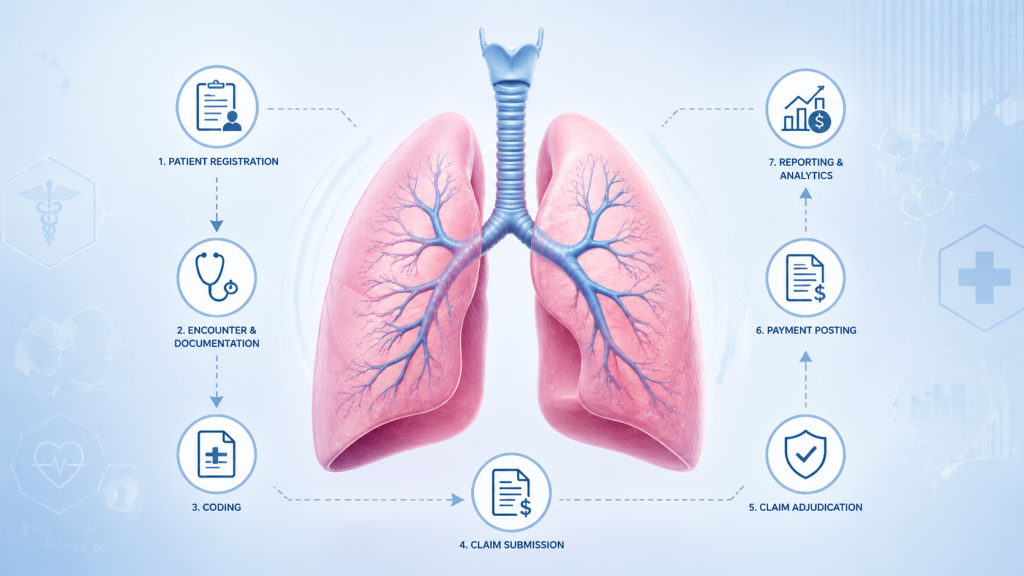
Pulmonology Medical Billing Overview
Pulmonology medical billing refers to the structured process of translating respiratory care services into accurate insurance claims and timely reimbursements. Because pulmonology often involves diagnostic testing, chronic condition management, and multiple procedures within a single visit, the billing process requires a higher level of precision than many other specialties.
Small documentation errors or missing details can easily lead to claim delays or denials, which directly affects revenue flow. For this reason, many practices look for structured support systems and industry guidance to improve accuracy and reduce administrative strain, often turning to experienced medical billing service providers like Zavisa RCM.
Pulmonology Services Typically Included in Billing
Pulmonology billing spans a wide range of clinical services, and each category carries its own documentation and reimbursement rules.
Diagnostic Services
Pulmonary function testing, spirometry, sleep studies, and imaging reviews all require precise interpretation.
Therapeutic Procedures
This includes oxygen therapy management, inhalation treatments, and bronchoscopic procedures where applicable.
Chronic Care Management
Patients with COPD, asthma, or pulmonary fibrosis often require long-term care coordination that must be documented and billed appropriately.
Critical Care and Hospital-Based Services
These services are often time sensitive and require detailed documentation of medical necessity and treatment duration.
Understanding the Pulmonology Revenue Cycle
The pulmonology revenue cycle begins at patient intake and continues until the final payment is posted and reconciled. Each step has a direct impact on reimbursement speed and accuracy.
Insurance verification is typically the first critical checkpoint. Before any services are provided, eligibility and coverage details must be confirmed to reduce the risk of avoidable claim rejections later.
Once care is delivered, accurate documentation becomes the foundation for claim creation. These claims are then submitted to payers for processing, and payments are eventually posted against the original billing records.
When issues arise, such as claim denials or partial payments, they must be addressed quickly through correction and resubmission. This follow-up stage is often where revenue is either recovered or permanently lost if not handled properly.
Common Challenges in Pulmonology Medical Billing
Pulmonology billing is often complicated by the nature of respiratory care itself. Patients frequently require multiple procedures during a single visit, which increases the risk of incomplete documentation.
In addition, insurance carriers regularly update their requirements, which forces billing teams to continuously adapt to new rules and submission guidelines.
Time constraints also play a major role. Providers are focused on patient care, and documentation tasks can sometimes fall behind, which leads to downstream billing issues that are harder to correct later.
Importance of Strong Clinical Documentation
Accurate documentation is the backbone of successful pulmonology medical billing. Every diagnosis, procedure, and treatment decision must be clearly recorded in a way that supports medical necessity.
A well-documented patient history helps ensure that claims are properly justified, while clear treatment records reinforce why specific services were required. Consistency across all medical records is equally important, as even small discrepancies can lead to audits or delayed reimbursement.
Strong documentation not only improves billing accuracy but also reduces administrative rework throughout the entire revenue cycle.
Compliance and Billing Accuracy
Compliance is a non-negotiable part of pulmonology billing. Practices must follow payer guidelines and federal regulations to ensure claims are processed correctly.
Because insurance rules frequently change, staying updated is essential. Even small updates in payer policies can affect claim acceptance if they are not properly implemented in the billing workflow.
Many practices rely on ongoing educational updates and structured billing insights, such as those shared through the Zavisa RCM Medical Billing blog to stay aligned with industry changes.
Managing Claim Denials Effectively
Claim denials are one of the most common challenges in pulmonology medical billing. They are often caused by missing documentation, or eligibility errors.
An effective denial management process starts with identifying the exact reason for the rejection. From there, the issue must be corrected and the claim resubmitted as quickly as possible to recover lost revenue.
Over time, tracking denial trends can help practices identify recurring issues and improve internal workflows to prevent similar errors in the future.
Role of Technology in Pulmonology Billing
Technology plays a major role in improving accuracy and efficiency in billing workflows. Digital systems help reduce manual errors, streamline claim submission, and improve tracking across the entire revenue cycle.
Automation tools support faster data entry and more accurate charge capture, while reporting dashboards provide visibility into financial performance and denial trends.
When implemented correctly, these systems significantly reduce administrative burden and improve overall billing consistency.

Outsourcing Pulmonology Medical Billing Services
Many pulmonology practices choose to outsource billing to reduce internal workload and improve revenue performance. Outsourcing allows providers to focus more on patient care while trained billing professionals manage claims, compliance, and reimbursement processes.
A strong billing partner should understand specialty workflows, maintain compliance standards, and actively manage denials to maximize revenue recovery.
Practices that want to explore professional support options can connect directly through the Zavisa RCM contact page to discuss service needs and workflow improvements.